This custom-built, two-story home offers 2,315 square feet of comfortable living space, with three bedrooms, a generously sized office that could easily serve as a fourth bedroom, and an attached oversized two-car garage that may optionally be moved with the house.
Designed to take advantage of a beautiful setting, the main living areas feature an expansive wall of windows spanning the living room, dining area, and kitchen—making this home especially well suited for a waterfront, near-waterfront, or other view-oriented property.
Originally custom designed and built for a single family, the home offers a thoughtful combination of open gathering spaces and more private bedroom areas. The main floor includes one bedroom and a large bathroom with an oversized soaking tub and separate walk-in shower.
The remaining bedrooms are located upstairs, thoughtfully separated from the more open living and entertaining areas below to provide comfortable, private spaces for family and guests.
With its generous proportions, flexible floor plan, and custom design, this home could serve equally well as a full-time family residence or a substantial vacation home—and begin a new chapter of family memories at its next location.
Contact us to learn more about the home and what would be involved in moving it to your property.
This tidy 1948 Seattle cottage is a solidly built and inviting small home, well suited for use as a detached accessory dwelling unit (DADU), guest house, or compact primary residence. Another option would be to place the house over a new lower-level garage at its destination, creating a carriage-house configuration.
The approximately 700 sq/ft single-level home has two bedrooms and one full bath, with a large, bright living room and galley-style kitchen with space for a small dining area. Large windows bring in plenty of natural light, and the original hardwood floors in the living room and bedrooms remain in good condition.
Practical updates include modern wood clad thermal-pane windows and simple electric baseboard heat—particularly convenient for a new site without natural gas service.
The attached garage adds approximately 260 sq/ft and offers additional possibilities. Depending on the new site and permitting requirements, it could remain garage or workshop space, potentially be converted to additional living area, or be replaced with a new garage-below configuration. There is also useful storage space above the existing garage.
With its compact footprint, straightforward one-story design, comfortable floor plan, and attractive original hardwood floors, this cottage offers plenty of flexibility and potential for its next location.
SHORT TIME REMAINING! PLEASE CONTACT US RIGHT AWAY FOR INFO!!
At 26-feet wide, this is a rare “narrow” house that can fit along significantly more roadways than usual due to width constraints. The house has had some great aesthetic upgrades over the years, including a roomy galley style kitchen with lots of storage and full height cabinets. The main living areas of the house total 1,060 sq/ft, and the unfinished garage adds an additional 390 sq/ft that could be converted to usable space as well, with a total of 1,450 sq/ft all on one floor.
One suggestion we often give is to consider a full daylight basement or lower floor once the house is delivered to your site, which would double your 1,450 sq/ft house to as much as 2,900 sq/ft total!
The three bedrooms allow for a family with kids, or for flexible space for office & guest bedroom. There is a small powder room that was added to the primary bedroom for convenience in the last renovation.
This is a well-built, functional, and affordable home for someone to make their own! The main rooms have been upgraded to an efficient, multi-head mini-split heat pump system (which allows both heating and cooling). This kind of heating/cooling is considered one of the most efficient from an operations standpoint, and since it runs on electricity it works in more remote locations that don’t have gas service available.
There is also a whole-house instant hot water system (typical costs between $2,000 and $3,500 when including install costs).
Please contact our office and ask to be referred to Jeff for more info on the home!
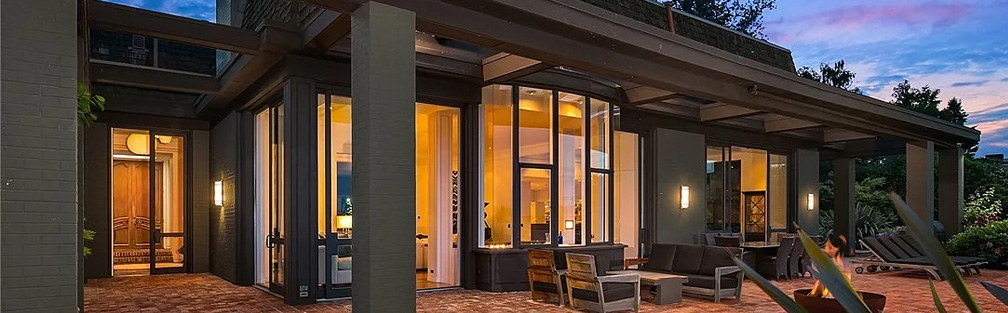
This “Levitt Lakeside Modern” is a large, architecturally significant waterfront home which will be spectacularly relocated in a single piece to your waterfront site!
The House Itself
Designed and built in 1969 by “Architect to the Stars,” Hal Levitt, from Southern California, the house is notable first for its sheer scale and clarity of plan. With 6,230 sq/ft of interior space arranged largely on a single level, the rooms are generous, well-proportioned, and deliberately separated into public and private zones. Ceiling heights vary throughout the house, reaching 11 to 13 feet in several primary living areas, lending a sense of openness and volume that is increasingly rare in contemporary construction. The main floor comprises 5,560 sq/ft of floor space, and a smaller portion, 570 sq/ft of the space is a “staff’s apartment” situated above two-car garage in an L-shaped configuration to the main parts of the house.
The interior spaces were clearly designed to accommodate both everyday living and large gatherings. Living and dining areas are expansive without feeling cavernous, while secondary rooms remain comfortably scaled and well connected. Multiple fireplaces, broad circulation paths, and wide openings between rooms reinforce the house’s emphasis on flow rather than compartmentalization. Throughout, the architecture favors calm progression and long sight-lines over dramatic gestures.
Architecture and Materials
The architectural language is confident and restrained: strong horizontal rooflines, deep overhangs, and extensive use quality materials and finishes anchor the house visually and structurally. Covered outdoor areas and large transitional spaces blur the boundary between inside and out, a hallmark of late-1960s modern residential design. This is a house that feels grounded and substantial, designed to age well rather than chase fashion. There have been extensive upgrades in the past, bringing the more public-facing parts of the house into the present with an upgraded kitchen, lighting, and electrical while keeping all of the architecturally important elements of the house pristine and original.
The Move
At approximately 130 feet in length, the relocation of this house is technically ambitious and unusually compelling. The plan is to move the structure in one piece, preserving its integrity and minimizing disruption to the building fabric. Moves of this scale are uncommon, but they are precisely the kind of challenge Nickel Bros is known for. The result will be a complete house—arriving whole, not reassembled—ready to be placed thoughtfully on its new waterfront site.
Designed for a Waterfront Setting
Although the site will change, the house’s relationship to water remains central. Its long elevations, covered terraces, generous glazing, and interior-to-exterior flow are ideally suited to a waterfront property. Relocated and oriented carefully, the house will feel neither transplanted nor compromised, but properly re-anchored to a setting that allows its design to function as intended.
Hal Levitt and the Architecture
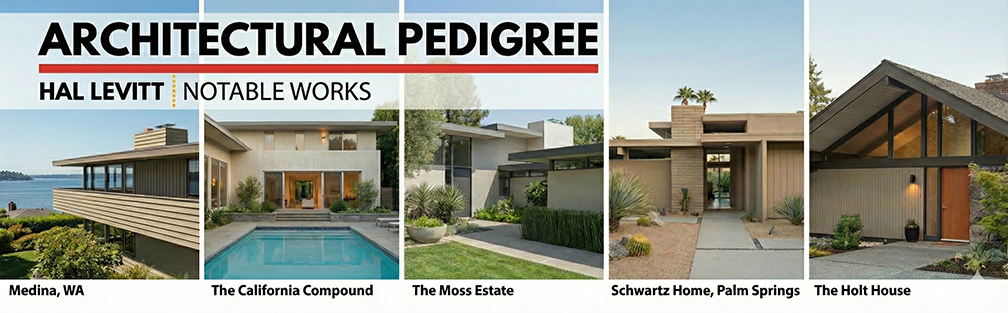
Harold Warren “Hal” Levitt (1922–2003) was a Los Angeles–based modernist best known for designing refined, highly private residences for Hollywood’s cultural elite. Often described as the “Architect to the Stars,” Levitt built his reputation in Southern California by creating homes that emphasized discretion, proportion, and livability over architectural showmanship.
Among the most notable figures to have commissioned or owned Levitt-designed homes are Steven Spielberg, Dean Martin, Burt Lancaster, Debbie Reynolds, Quincy Jones, Lionel Richie, and Ellen DeGeneres. His appeal to this clientele was rooted in a consistent architectural approach: clear planning, generous but controlled spaces, strong indoor-outdoor relationships, and a material palette that conveyed permanence without ostentation.
While Levitt’s work is firmly associated with Hollywood and Southern California, his career includes a small and little-known Pacific Northwest chapter. A Levitt-designed waterfront home in Medina, Washington is often cited as his only documented commission in the region. Levitt Lakeside Modern expands that narrative. Long overlooked within Levitt’s body of work, the house reveals its authorship clearly when viewed alongside his California designs: the horizontal emphasis, the measured procession of spaces, and the quiet authority that defined his best work.
That this house remained largely unrecognized as a Levitt design for decades only adds to its intrigue. It stands as a rare Northwest expression of a modernist more commonly associated with Hollywood—an architectural outlier whose pedigree becomes unmistakable once you know where to look.
Harold W. Levitt: The Master of Hollywood Modernism
Harold Warren “Hal” Levitt (1922–2003) was a pivotal figure in mid-century residential design, operating at the intersection of high-stakes Modernism and the discrete glamour of Hollywood’s golden era. A graduate of Stanford and USC, Levitt refined his craft under the mentorship of legendary architects Roland Coate and Burton Schutt before establishing his own practice in Beverly Hills in the 1950s. He quickly became the architect of choice for Los Angeles’ cultural and cinematic elite, earning him the enduring moniker of “Architect to the Stars.”

An A-List Pedigree
Levitt’s commissions read like a historical registry of 20th-century entertainment. His ability to balance programmatic clarity with total privacy made his work essential for figures such as:
- Steven Spielberg: A noted enthusiast of the Levitt aesthetic who has owned and inhabited Levitt’s iconic Beverly Hills work.
- Ellen DeGeneres: A sophisticated collector of modern architecture who has restored multiple Levitt properties.
- Dean Martin, Burt Lancaster, and Debbie Reynolds: The icons who defined the “Hollywood Regency Modern” lifestyle in the 1960s.
- Quincy Jones and Lionel Richie: Who sought out Levitt for his homes’ legendary acoustic and entertaining volumes.
The Architectural Language
Levitt’s work is characterized by horizontal rigor and volumetric play. His designs emphasize the “long view,” utilizing deep roof overhangs and expansive glass planes to dissolve the boundary between the interior and the landscape. Unlike many of his contemporaries who favored stark industrialism, Levitt’s Modernism was grounded in permanent, substantial materials—stone, terrazzo, and high-grade timber—creating homes that felt authoritative rather than transient.
A Rare Northwest Chapter
While Levitt’s legacy is rooted in the canyons of Bel Air and the Trousdale Estates, he occasionally exported his California Modernism to the Pacific Northwest. For decades, his 1972 waterfront treasure on Fairweather Lane in Medina—famed for its 18-foot floor-to-ceiling windows—was considered his only documented regional commission.
The “Levitt Lakeside Modern” (1969) expands this narrative significantly. Long a “quiet” masterpiece in the Seattle area, the house reveals its undeniable authorship through its measured procession of spaces and its sophisticated, discrete entry sequences. Saving this structure is more than a relocation; it is the preservation of a rare northern outlier from one of the most influential residential architects of the 20th century.
Historical References & Further Exploration
The Northwest Connection
Iconic California Masterpieces
Architectural Archives
A Note on the Spielberg Connection: While Steven Spielberg’s semi-autobiographical film The Fabelmans explores the tract-home aesthetic of his youth, the director’s adult life has been defined by an appreciation for high-modern architecture. Spielberg’s ownership of a major Hal Levitt estate in Southern California is often cited as a testament to the architect’s ability to create “cinematic” spaces—homes that frame the landscape with the same intentionality as a director frames a shot.
This Cozy Cottage is perfect as a second home or beach property. It is well-built with an open plan and perfect for family gatherings and vacations.
You enter the cottage into a large living space with living room, dining area, and kitchen. To the left there is a nicely-sized master bedroom, and to the right there is a small bunk room, which is perfect for kids!
At 650 square feet and narrow, this home will fit down most roadways to reach your property where others may not. If you need more space, raise it up for a full daylight basement, allowing you to affordably *DOUBLE* your square footage.
You will make many memories here! Call your local office today for more information or to arrange a viewing!
Note: Must be barged (cost determined by destination).
Walkthrough Video